
Run a Schley County Property Search in Five Moves
Schley County points searchers to Schneider qPublic for assessor data. Begin there with an address or owner name when you have one, and write down the parcel number right away. The county's live screen loads dynamically, so confirm the exact control labels and parcel-number formatting inside the application itself rather than relying on assumptions.
- Enter the physical address in the county-linked qPublic application.
- Open the likely parcel and copy its owner, situs, mailing address, legal description and APN.
- Carry the owner and deed reference to GSCCCA to inspect the recorded conveyance.
- Use the same APN or address in AssuranceWeb and the parcel map.
- Request a missing record from its custodian or order the needed recorded copy.
Start With Situs, Not the 31806 Mailing Line
The situs is where the land actually sits. The mailing address is simply where the owner gets correspondence. Ellaville and ZIP 31806 are mailing clues. They are not proof that a parcel lies inside the city limits. Official planning material notes development outside the compact boundary along U.S. 19 and Ebenezer Road. Before sending a permit or zoning question to the city, match the candidate parcel by number. Also confirm it by map location.
An address that fails may still work. Strip a directional, suffix or unit number and try again. If it keeps failing, search the owner's name and compare legal descriptions instead. Older Schley County deeds may identify land by Pond Town, Hawthorne Trail or a rural route. They may also cite a creek, a church, an adjoining owner or acreage rather than a modern street number.
The Schley qPublic Starting Point
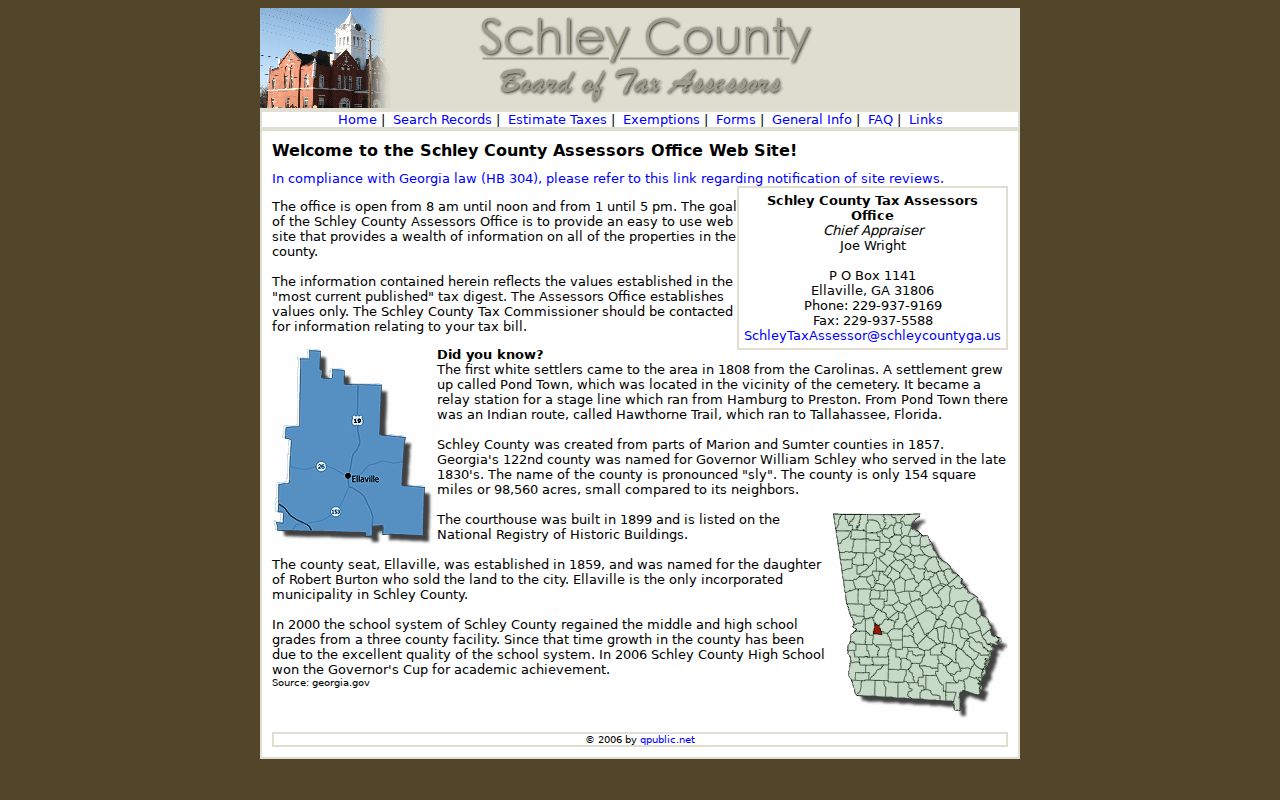
The Schley County assessor maintains current ownership records and maps, qualifies sales, and values property. The office also mails Notices of Assessment. It handles exemptions and appeals. The official Schley qPublic page links directly to the parcel application. Standard qPublic interfaces offer owner-name, location-address, parcel-number and legal-information search modes. The county's own deployment loads through a Cloudflare gate. Its precise controls are best confirmed in the live application.
Save the Parcel Number, Legal Description and Book/Page
These three identifiers tie separate systems together. The parcel number keys the tax roll and map file. The legal description tests whether two results actually concern the same land. Book and page retrieves the recorded deed instrument itself. Note: keep the tax year, source and retrieval date with every record you save. Ownership and values change on different schedules.
- Parcel number or APN
- The assessor's identifier for a mapped tax parcel, not a deed itself.
- Situs address
- The physical property location.
- Owner of record
- The name maintained in the current government record, which can lag a new filing.
- Book/page
- The recording citation used to retrieve a deed or related instrument.
Read a Schley Property Result Field by Field
Capture a property search result as a bundle, not just a name. The live parcel card is dynamic, so verify the field labels and update date on the current result.
| Owner of record | Current digest name; confirm against the newest deed |
|---|---|
| Situs / mailing address | Physical parcel versus correspondence destination |
| Parcel number | Cross-key for map, assessment and tax searches |
| Market / assessed value | Tax-year figures, with Georgia's general 40% assessment level |
| Legal description | Lot, block, tract, acreage or metes-and-bounds clue |
| Sale reference | Date, consideration and recording pointer that require deed confirmation |
Keep the parcel card in perspective. It is an index and tax-administration record, not a title guarantee. It cannot establish clear title, physical occupancy, an exact surveyed line or an independent appraisal.
Move From qPublic to the GSCCCA Deed Index
Search the GSCCCA Real Estate Index with Schley selected. Individuals appear last-name-first. Party type, instrument type, dates and the neighboring-county control can narrow or widen a deed search. Compare the assessor's legal description and last-sale reference against the deed image itself. Statewide all-county coverage runs reliably from January 1, 1999. Earlier Schley County deed work may still require the clerk's physical books.
Owner-name searching takes care with initials, suffixes, trusts, estates and business entities. Never merge two people who share a name without matching the property description. A freshly recorded deed can also be more current than the assessor's tax roll.
Check Tax Status and City Development Records
Once you have the parcel, open AssuranceWeb for tax status. Its modes include Name, Bill Number, Company, Parcel and Address, plus a tax year selector. This confirms billed amounts and payment status, not title. For land inside Ellaville, request building permits and inspections from City Hall by site address; the city publishes a permit form but no public results database.
The permit application records owner, contractor, improvement, use and construction details. Its site plan asks for lot dimensions, easements, watercourses, fences, rights-of-way and abutting-property information. Those details can explain physical changes to a parcel. Just remember that a permit applicant is not necessarily the deed grantee.
Choose Address, Owner or Parcel for a Schley Search
Each search key solves a different failure. Address feels intuitive, owner name casts a wider net, and parcel number is the strongest exact cross-reference once you have it.
| Search Key | Best For | Where It Works | Watch Out |
|---|---|---|---|
| Address | One physical site | qPublic, map, AssuranceWeb | Postal city, suffix and older numbering |
| Owner name | Possible holdings or deed parties | qPublic and GSCCCA | Initials, entities, trusts and same names |
| Parcel number | Exact tax parcel | Assessment, tax and map systems | Formatting and parcel splits |
Not a title search. A Schley County property search assembles public index and tax evidence. It does not guarantee clear title; a title professional or attorney evaluates that question.
Request the Record When an Online Search Stops
Contact the assessor at 229-937-9169 for parcel-card, ownership, map, exemption or appeal questions. Contact the Superior Court clerk at 229-937-5581 for deeds, plats and older books, and the Tax Commissioner at 229-937-2689 for bill status. Georgia Open Records Act requests should identify the desired record and date range; agencies generally must respond within three business days even when production takes longer.
A useful request names the record rather than asking an office to research a conclusion. Give the parcel number, exact parties, approximate date range, document type, known book/page and preferred electronic or paper format. Ask about cost before authorizing a broad search. At the clerk counter, take both modern and historical place terms; at the assessor, ask for the parcel card or map record for a specific APN; at the commissioner, identify both bill and tax year.
For a historical address bridge, the Schley County Library and local Historical Society are documented fallbacks. The library offers a $10 local-history research request covering the first five copies, with additional copies at $1. Supply names, approximate dates, road or community terms and the known deed reference. Historic newspaper runs include the Schley County Enterprise from 1886 and the Schley County News from 1889 into 1939. Sale notices, estate notices, road descriptions and adjoining names can connect an old tract to a modern parcel.
When results conflict, do not choose the most convenient screen. Compare effective and recording dates, distinguish situs from mailing address, and ask the responsible custodian whether a later deed, parcel split or correction has not yet propagated to the other system. Preserve a screenshot or copy with its retrieval date so the discrepancy can be explained.
Resolve Same-Name and Entity Results Carefully
An owner search in Schley County can pull up unrelated people, spouses listed under different name orders, trustees, estates and entities with punctuation variations. Search broadly first. Catch initials and suffixes. Then narrow by county, date and instrument. A shared surname proves nothing. Parcel number, legal description, situs and book/page must converge before you call it a match.
For companies, keep the assessor's exact spelling. A Georgia business record can clarify the entity name, though an officer or registered agent is not automatically its landowner. A recent deed may also precede an assessor update, and a split can create new APNs, so compare dates, retain old and new identifiers, and ask the custodian about unexplained mismatches.
Finish with a consistency check. The situs, APN and legal description should point to one parcel. The deed's grantee and recording date should explain the ownership claim. The tax account should use the intended year. Any Ellaville permit should concern the same site. Record disagreements openly instead of blending them. A dated statement such as "shown on the assessor roll but superseded by a later recorded deed" beats declaring a single screen current without qualification.
A failed search is not an absent record. Portal punctuation, abbreviated road names, name order, browser blocking and limited date coverage can all hide a real result. Try a second key. Broaden the date or name variant, then use the office fallback. When requesting help, state what you searched and which identifiers surfaced, so staff can locate an existing record rather than run an open-ended investigation.