
What Schley County Property Tax Records Contain
Two Schley County offices split the work of property tax records. The Board of Tax Assessors keeps current ownership, parcel maps, qualified sales, fair market values, exemptions and appeals for the digest. The Tax Commissioner handles the money side of the tax roll, meaning tax bills, payments and delinquencies. Each office answers a different question about the same parcel. Before comparing anything across the two, match the records by parcel number and tax year so the figures line up correctly.
| Field | What It Shows | Where |
|---|---|---|
| Fair market value | Assessor's estimate of full value for the year | Board of Tax Assessors |
| Assessed value | Generally 40% of fair market value in Georgia | Board of Tax Assessors |
| Exemptions | Approved reductions or special treatment | Assessor and Tax Commissioner |
| Bill and status | Amount billed, balance and payment state | Tax Commissioner |
| Delinquency or sale notice | Collection stage requiring current confirmation | Tax Commissioner and county notices |
Georgia sets taxable property at 40% of fair market value in most cases. A special treatment can change that figure. The tax bill then applies millage rates and exemptions to that taxable base. A recorded sale price sits somewhere else entirely. It lives in the deed and its PT-61 real estate transfer trail. Neither the bill nor the parcel card counts as a private appraisal of the property.
The Assessor and Tax Commissioner Have Separate Jobs
Chief Appraiser Joe Wright runs the assessment side of Schley County property tax records from the Court House Annex at 47 N. Pecan Street. His office produces the uniform digest, maintains ownership records and maps, reviews qualified sales, mails Notices of Assessment, and processes exemptions and appeals. Reach the assessor at 229-937-9169 or open the Schley qPublic information page. Hours are 8 a.m.–noon and 1–5 p.m.
Tax Commissioner Jessica Ellis Smith collects property taxes and administers the online bill route. Her office uses P.O. Box 326, Ellaville, GA 31806, phone 229-937-2689 and schleytaxcomm@gmail.com. Send value questions to the assessor. Balance, receipt and payment questions belong with the commissioner.
AssuranceWeb Search Fields for Schley Tax Bills
The official AssuranceWeb property search for Schley County offers a Tax Year selector and a Search By control. Search modes include Name, Bill Number, Company, Parcel and Address. Name mode asks for the owner of record's last name and allows either a "starts with" or "contains" match, which helps when spelling is uncertain. Always confirm the address and parcel number on the result before relying on any tax bill it returns.
| Search mode | Best starting fact | Verification |
|---|---|---|
| Name | Owner's last name | Match parcel and situs |
| Bill number | Number on a notice | Confirm tax year |
| Company | Entity owner wording | Check exact entity and parcel |
| Parcel | Assessor APN | Best cross-office match |
| Address | Physical property location | Distinguish situs from mailing address |
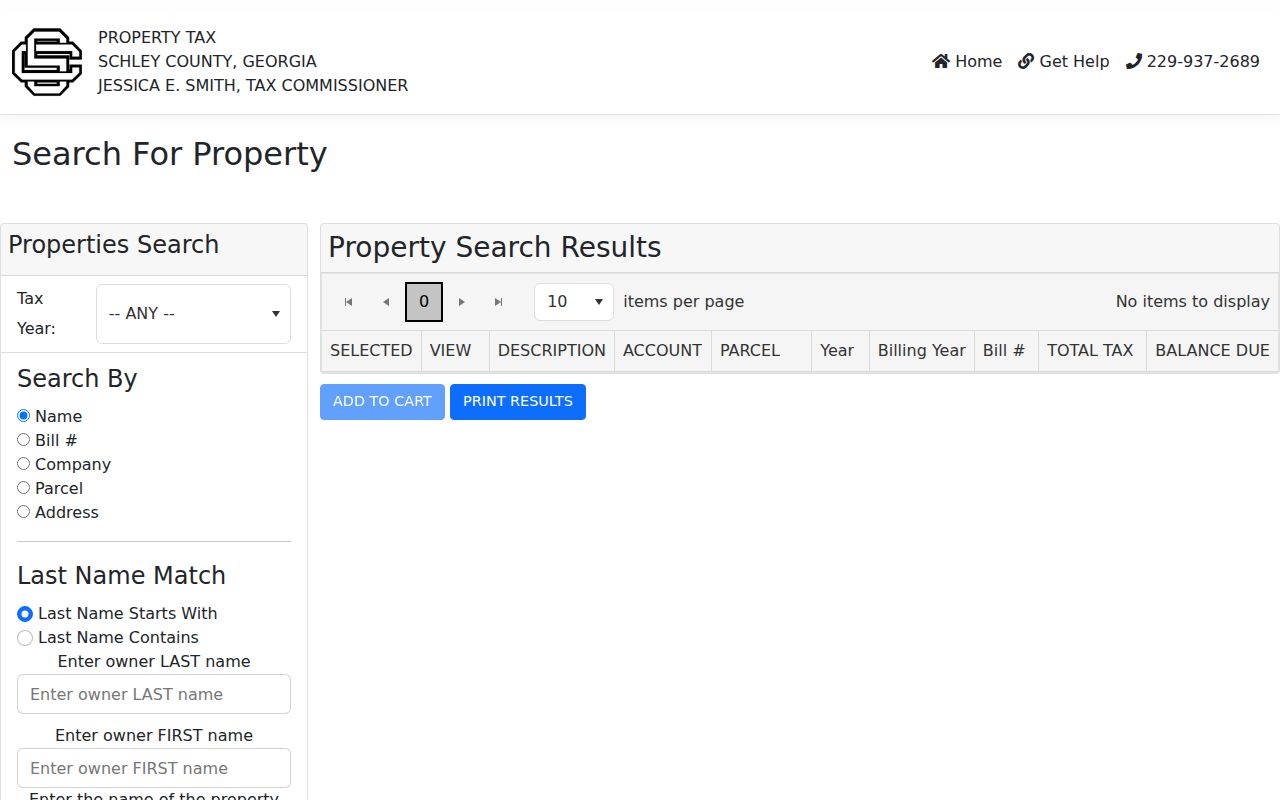
Trace a Schley County Tax Bill From Parcel to Payment
Start with the current tax year in AssuranceWeb. Search by parcel number when you have it; otherwise try the situs address or owner last name, resolving any ambiguous match against qPublic. Record the bill number, parcel, year, amount and payment status as one set.
- Choose the correct year and search AssuranceWeb by parcel or address.
- Read the bill, balance and payment status without mixing years.
- Compare value and exemption fields with the assessor's qPublic record.
- Check official county notices and contact the Tax Commissioner if delinquency or sale is indicated.
- Assessed value
- The statutory assessment-level amount before applicable exemptions.
- Mill rate
- Tax per thousand dollars of taxable value.
- Homestead exemption
- Relief that depends on qualification and approval, not merely a mailing address.
- Tax lien
- A government claim arising from unpaid property tax; verify its current status.
Schley Homestead, Senior and Land-Use Relief
Schley County relief comes in several forms. Assessor materials point to homestead relief, local senior provisions and an HB-918/919 value freeze. Georgia Department of Revenue materials document veteran and current-use agricultural or conservation programs. Eligibility, filing and renewal rules differ by program. Check the official Schley exemptions page. Then confirm the actual exemption code on the parcel and bill.
A 2025 county release on HB 581 described a statewide homestead value-increase cap. It took effect January 1, 2025. Not every parcel got identical treatment. Verify qualification and the particular tax-year calculation before relying on either figure.
Millage Notices and the 2026 Delinquent Sale Link
Schley County published a proposed-tax-increase notice in October 2025 describing a tentative 13.094-mill rate. The county's documents page carries annual digest and millage materials, and the taxes page linked a September 1, 2026 delinquent-property-tax sale. Dated notices give context. They do not replace the current parcel bill.
A tax sale link signals a collection process, not an ordinary deed transfer or proof of present ownership. Confirm redemption and procedural status with the Tax Commissioner. Examine later recorded instruments through GSCCCA before drawing conclusions.
Evidence That Clarifies a Schley Value Dispute
A strong assessment review separates factual correction from value opinion. Check parcel identity first. Acreage, land class, improvement type, dimensions, condition and any exemption all matter. Then compare sales from the appropriate period that the assessor could regard as qualified. A family deed, gift, foreclosure or estate transfer may be recorded yet still fail as an open-market comparison.
Keep your file organized. The Notice of Assessment, qPublic card, photographs and repair estimates belong together. Relevant deeds and comparable-sale details belong in the same file. State the tax year on every value. A boundary or acreage dispute can be flagged by a deed or tax map. A licensed survey may be needed to establish the line. A bill-calculation issue is different. Take the assessment and exemption data to the Tax Commissioner rather than filing an appraisal appeal.
Georgia's 40% assessment level prevents a common misreading. Assessed value is not the assessor's full market estimate. Taxable value may differ again after exemptions or current-use treatment. A year-over-year bill change can arise from value, exemption, millage or district factors. Compare the full calculation rather than one number.
Appeal a Schley County Assessment Within the Notice Window
Schley County owners get a real window to challenge an assessment. The law generally allows 45 days from the date on the Notice of Assessment. Owners then file an appeal with the Board of Tax Assessors. Mark that date the moment the notice arrives. The clock starts there, not when the envelope is opened. Filing usually runs through the state's PT-311A form or whatever local method the county accepts. The appeal should state its grounds clearly, and proof of timely submission should be kept on hand.
Strong evidence makes the case. A parcel-card correction can support the claim. So can comparable qualified sales, photographs, repair estimates, or a professional appraisal. From there the appeal may move to the Board of Equalization or another authorized route. Confirm the exact instructions on the notice and with the Schley County assessor.
Forty-five days controls. File from the Notice of Assessment date with the Schley County Board of Tax Assessors. A tax-bill dispute and a value appeal are not interchangeable.
Keep Tax-Year Context With Every Schley Figure
Match every Schley County figure to its tax year. Fair market value, assessed value, taxable value, exemptions, district, bill number, amount, and status all belong together. Keep them tied to the year you select. Numbers drift badly when one digest gets paired with another year's millage rate. Pull each prior-year bill instead of guessing that the newest result explains an older calculation.
Names can lag too. The latest deed may show a new grantee. The assessor and the tax roll may still carry the former owner of record. Paying a bill proves nothing about title. A delinquent listing does not confirm that a tax-deed transfer has closed. For live balances, check with the Tax Commissioner. For historical work, lean on the county digest and millage records.
Three documents settle most Schley County tax questions. Reconcile the Notice of Assessment, the assessor's parcel card, and the Tax Commissioner's bill whenever all three are available. The notice pins down the appeal deadline. The parcel card backs the digest fields. The bill shows the charge and payment status. Hold any delinquent-sale notice apart. Wait until the office confirms the parcel, the procedural stage, and the current amount. That discipline keeps an old notice from becoming a claim. It also guards against a cached portal result.