
Read Schley County's Present Owner Record
The county-linked qPublic application is the starting source. The Schley County Tax Assessor maintains current ownership records and maps while preparing the annual digest. Use it for a quick property search. The office publishes no fixed refresh interval for the parcel card, so record only what the card actually shows. Note the day you retrieved it.
| Owner of Record | Name shown on the current assessor card |
|---|---|
| Vesting | Read from the latest deed, not inferred from the card |
| Mailing Address | Tax-notice destination, not proof of occupancy |
| Situs Address | Physical location assigned to the parcel |
| Deed Reference | Book and page tying the name to the instrument |
| Recording Date | Date the clerk accepted the deed |
Save the parcel number, legal description, exact owner spelling, mailing entry, and retrieval date. Those details form a compact owner-of-record card. Compare it later with the clerk's deed index. A mailing entry can be a post office box, a business address, or a representative, and it never proves who occupies the situs.
Check Schley County's Digest Date
The assessor record is a tax-digest view. Schley County posts no dependable interval between a deed's recording and the next owner update on the digest. That gap matters most right after closing, when the former name can stay on qPublic even though a newer deed has already reached the clerk. Capture the current owner exactly as displayed, with initials, punctuation, fiduciary words, and entity suffixes. Do not invent an update schedule. Then compare the result with the deed recording date. Never assume the tax year proves the day the name changed.
The official Schley County assessor page documents the office's role in maintaining current ownership records and maps. Check the parcel card for the tract itself. That live result is where the current owner appears.
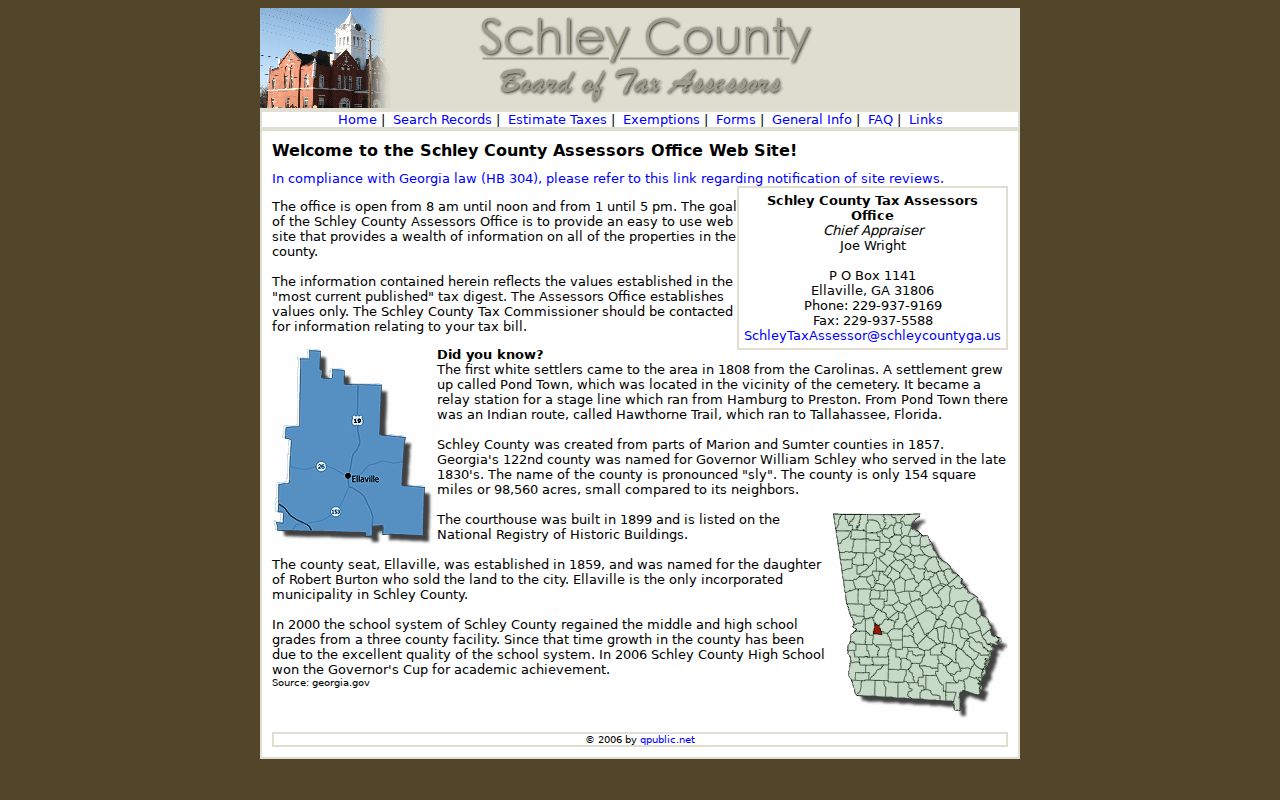
The assessor page confirms which office is responsible. The live parcel result, not the page image, is where you capture the actual current owner for a single tract.
Confirm Schley's Current Owner With the Latest Deed
To verify the current owner of record, run the assessor's name as grantee in the GSCCCA Real Estate Index. Narrow the results to Schley County. Look for the most recent conveyance whose legal description matches the parcel in question. Each entry lists the parties, the instrument type, and the property location. It also shows a book/page citation you can pull at the clerk's office. Solid all-county coverage starts in 1999. For older Schley County deed records, the clerk's physical books are the place to go.
- Read the owner of record and APN on qPublic.
- Search the exact name and variants in the GSCCCA index.
- Compare recording date, instrument type, book/page, and land description.
- Obtain the deed image or ask the clerk when the index is unclear.
- Owner of record
- The party named in the public record being consulted.
- Vesting
- The way the deed states that ownership is held.
- Registered agent
- The designated recipient for service on a Georgia entity.
The newest matching deed can be more current than the digest. Read the deed image when one is available. Index classification alone cannot explain the interest conveyed. Images and premium functions may require a GSCCCA account, and the Clerk of Superior Court can supply the official document path whenever online access stops.
Use Schley's Recording Date
Three dates answer different questions. A deed may be signed at closing and recorded later, and the assessor may then qualify that sale for valuation on still another schedule. That lag is normal. For a current owner answer, the clerk's recording date and the matching legal description carry more weight than a last-sale line alone.
Keep three keys together. Save the APN, legal description, and deed book/page so the same Schley parcel can be matched across separate systems.
Decode Schley County Entity Owners
Entities own land too. A current owner may appear as an LLC, corporation, trust, estate, or fiduciary instead of an individual. Search an LLC or corporation under the exact assessor spelling in the Georgia Secretary of State Business Search. The entity record shows its control number, status, registered agent, and officers. None of them is the landowner without a deed saying so. For a trust, read the grantee and vesting clause.
Estates take their own deed forms. Look for a deed of assent, executor's deed, or administrator's deed in the Superior Court records, and consult Schley Probate Court when authority or succession is unclear. A life-estate deed divides possession from remainder. A short owner label can hide that.
Preserve Schley Deed References
Book and page tie a current owner name to the recorded deed. Copy both. Add the instrument type, grantor, grantee, and recording date. A corrected deed, quitclaim deed, foreclosure deed, or estate deed can appear near the same date, so do not settle for the first familiar name. Read every relevant instrument.
For an ordinary or certified copy, contact Clerk Kimberly McKinney at 47 N. Pecan Street, P.O. Box 7, Ellaville, or 229-937-5581. Ask by party, approximate date, instrument type, book and page, parcel or legal description, and copy type. The focused request helps staff find the newest deed.
Use a Schley Owner Mailing Entry With Care
The tax-roll mailing entry is only a contact clue. It may not be the owner's residence. Keep it separate from the situs address, which identifies the parcel's physical location. A 31806 mailing city proves little. Development runs past Ellaville's compact city edge along parts of U.S. 19 and Ebenezer Road, so a tract with that ZIP can sit outside the city boundary.
Lawful use. Use owner data for legitimate property matters; never use it to harass, intimidate, or target any person.
When the two addresses differ, that is not an error. Rural land, vacant tracts, entity-owned parcels, and tax correspondence handled by a representative can all create a valid difference.
Ask Schley's Custodian Directly
qPublic hides some cards. When it does, go straight to the Tax Assessor. Ask for the parcel card, ownership history, map or sketch, sale history, and any assessment notices tied to the APN. The office sits in the Courthouse Annex at 47 N. Pecan Street, P.O. Box 1141, Ellaville. Chief Appraiser Joe Wright answers at 229-937-9169. The Georgia Open Records Act accepts oral requests. Put yours in writing, though, to preserve enforcement rights. The agency generally must produce the record, or send an estimate or exemption notice, within three business days. The first 15 minutes of search and retrieval time cost nothing, and ordinary copies stay capped at $0.25 per page under O.C.G.A. §50-18-71.
Monitor New Schley Recordings
Ownership can shift after your check, though. The free GSCCCA Filing Activity Notification System watches later filings tied to a name or property. Treat FANS as an alert, not proof. A notice does not mean the filing is valid or that title actually changed. Open the indexed instrument itself. Then contact the clerk about anything unexpected, and remember that a purchase, estate transfer, or correction deed warrants a fresh current-owner check whenever a decision rides on today's record.
Resolve Schley Current Owner Conflicts
First, confirm both results describe the same land. Compare the APN. Then check the legal description, subdivision or lot references, and any book/page on the parcel card. Nearby tracts breed false conflicts. So do similar names. A corrected instrument can explain the pair, too. Next, sort the evidence by date and purpose. The assessor name exists for tax administration, while the deed records a conveyance. A newly recorded deed matching the parcel can postdate the digest display. Still, an index row alone proves little, so read the instrument for vesting, exceptions, and the precise interest conveyed. If the conflict survives, give both references to the assessor and clerk and ask whether a transfer awaits digest processing. For purchase or title reliance, seek qualified title assistance rather than forcing the discrepancy into a legal conclusion.
Document Schley's Owner of Record
A solid answer names its sources. Record the retrieval date, the exact current-owner label, APN, situs, mailing address, deed book/page, instrument type, grantee, and recording date. Mark anything the portal did not expose as unverified. That label keeps a later reader from mistaking a blank field for a negative finding. Better yet, link the answer to the record itself. For the wider address-to-owner method, see Who Owns This Property. Walk the prior chain through Former Property Owners, or pull the recorded instrument from Schley County deed records. Each page answers a different piece of the puzzle.