
A Practical Route Through Schley County Property Records
Begin with the assessor's qPublic route. A street address, owner name, or parcel number there yields the cross-reference you need. That cross-reference opens the statewide GSCCCA deed index, the AssuranceWeb tax search, and the county-linked parcel map. Inside Ellaville, a city permit request can add development history. Ownership and value, though, remain county records.
Every system answers a narrower question than you might expect. An assessor name can lag a freshly recorded deed. An index entry omits terms visible only in the image. A tax bill is not a sale appraisal. A GIS line is not a survey.
- Search qPublic by address or owner and save the parcel number.
- Use the current owner and book/page clue in the GSCCCA deed index.
- Choose the correct tax year in AssuranceWeb and verify exemptions and balance.
- Compare the parcel and zoning maps with the written legal description.
- Ask the custodian for missing, older or certified material.
The Offices Behind Schley County Property Records
Schley's courthouse network is compact, yet it still splits duties four ways. The Superior Court clerk records deeds and plats. The Board of Tax Assessors maintains digest ownership, maps, and values. The Tax Commissioner handles bills and collections. When title passes through estate administration, Probate Court supplies the context.
Schley County Superior Court Clerk
47 N. Pecan St., P.O. Box 7
Ellaville, GA 31806
229-937-5581
Schley County Board of Tax Assessors
47 N. Pecan St., P.O. Box 1141
Ellaville, GA 31806
229-937-9169
Address, Owner and Parcel Are Different Search Keys
A situs address identifies the physical site, but the owner's mailing address may sit elsewhere. An Ellaville mailing line with ZIP 31806 does not establish city limits. Searching by owner can surface multiple holdings. It also collides on initials, trusts, and LLCs. Once you land a match, the parcel number becomes the strongest bridge across assessment, tax, and map records. The legal description and book or page reference then carry you into the deeds.
| Starting fact | First source | Next verification |
|---|---|---|
| Street address | qPublic parcel search | APN, map and deed |
| Owner name | qPublic and GSCCCA | Legal description |
| Parcel number | Assessor, tax and map | Recorded book/page |
Schley Deeds Cross the 1999 Digital Line
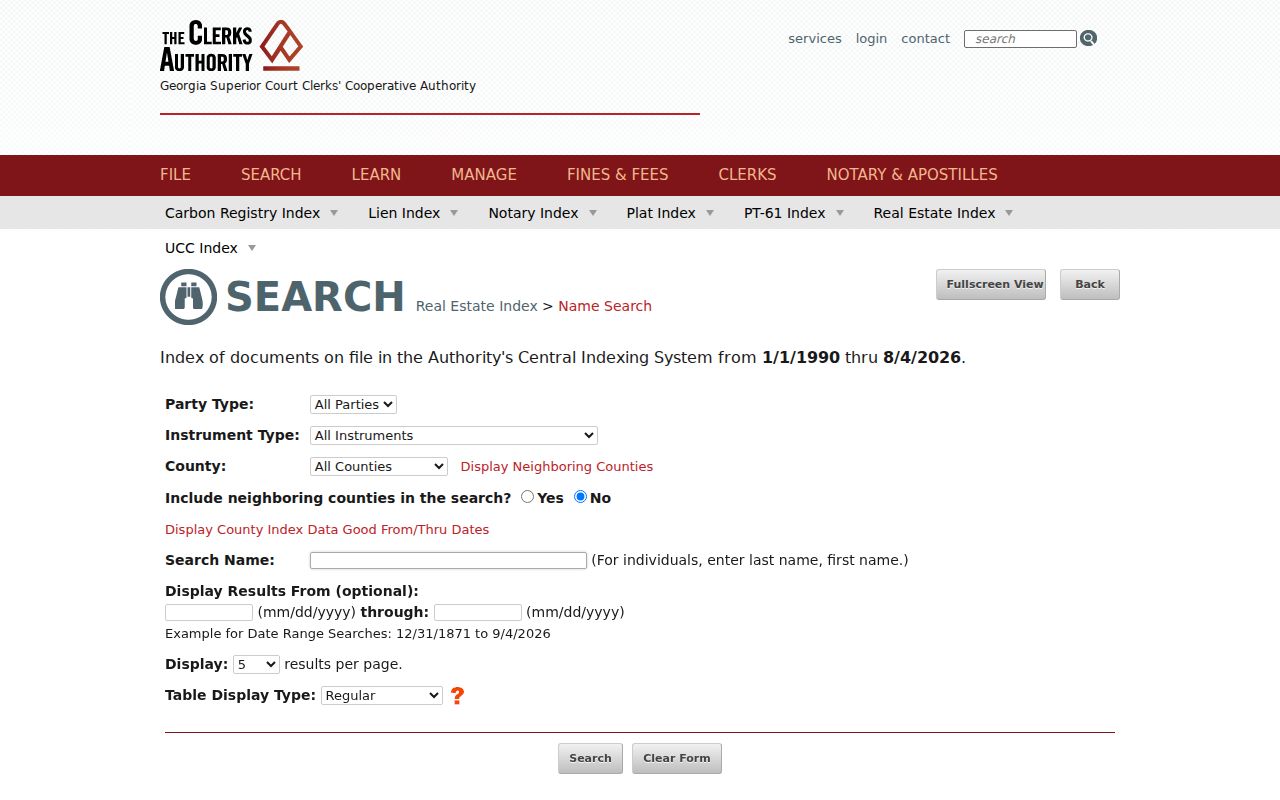
The GSCCCA name search lets you filter by party type. You can also filter by instrument type, county, dates, and neighboring-county scope. Its all-county real-estate coverage runs reliably from January 1, 1999. Earlier Schley chains belong in the clerk's physical books unless local coverage is confirmed.
Work backward. Find the current owner as grantee. Read the grantor and legal description. Then locate that grantor's earlier acquisition. Schley was formed from Marion and Sumter in 1857, so older chains can branch into the parent counties.
Tax Years, Values and Schley's Current Notices
AssuranceWeb accepts Name, Bill Number, Company, Parcel, and Address searches, with a Tax Year selector. Georgia generally assesses property at 40% of fair market value. Exemptions or special programs apply after that. Schley materials identify homestead, senior, and veteran relief, plus a local value freeze. Agricultural and conservation treatment also appears in those materials.
A tentative 13.094-mill rate appeared in the county's October 2025 notice. Its taxes page linked a September 1, 2026 delinquent sale. Treat those as dated context, not substitutes for the current bill. Check the county documents collection, then confirm a parcel's status with the Tax Commissioner.
Which Schley Property Record Answers Which Question
Match the record to the question, not to whichever portal ranks first. A transfer lives in the deed image. Assessed value lives in the digest, payment in the tax system, boundary context in a map or plat, and construction history in a permit file.
| Record Type | What It Documents | Kept By | Access |
|---|---|---|---|
| Deeds | Recorded transfers and descriptions | Superior Court clerk | GSCCCA or clerk |
| Mortgages and liens | Recorded encumbrances, releases and cancellations | Superior Court clerk | GSCCCA indexes |
| Assessment and tax | Digest value, exemptions, bill and status | Assessor / Tax Commissioner | qPublic / AssuranceWeb |
| Plats and parcels | Lot, tract and mapped context | Clerk / assessor | Plat index and map |
| Building permits | Proposed work and inspection history | City of Ellaville | Direct request by site address |
Turn to Schley County deed records for the grantor-grantee chain. For valuation, exemption, and bill procedures, property tax records is the right page.
Parcel Maps Give Context, Not Surveyed Lines
Schley County links its parcel work through qPublic. An official 2021 zoning PDF visibly uses Rural, Industrial, and Wildlife Preservation categories. Georgia's GIS Clearinghouse provides downloadable parcel context. GDOT GeoPI adds roads and transportation features. A mapped line can help you spot adjoining APNs or the correct plat. But only a licensed survey resolves an exact boundary.
For adjacent parcels, select the subject. Note every touching parcel by hand. Then search each APN separately. Preserve the map date and scale. Splits and redraws can alter the tax map without ever rewriting an older deed.
Ellaville Permits Follow the Site Address
Ellaville is Schley County's only incorporated city. Its permit form records the owner, contractor, proposed use, structure details, and construction cost. It also requires a site plan showing lot dimensions, buildings, easements, and watercourses. The plan must also show fences, rights-of-way, and abutting property. The city publishes no permit-results database. So request the completed application and inspection history from City Hall.
The city is compact. Still, official planning material notes development outside the limit along U.S. 19 and Ebenezer Road, so verify the municipal boundary before assuming city permitting applies. A permit name may be an applicant or contractor and proves nothing about deed ownership.
From Pond Town to the 1899 Courthouse
Local record language predates modern addresses. Pond Town began as a stage relay near the present courthouse around 1812. Schley County was created in 1857. The town was laid out in 1858, and Ellaville incorporated in 1859. Courthouse records preserve that Robert Burton sold 150 town-site acres for $1,500. That corrects the tale that the land was donated.
The current courthouse dates to 1899. For older tracts, search road, creek, church, acreage, and adjoining-family terms. Use those alongside Pond Town or Hawthorne Trail. The Schley County Library offers a $10 local-history research request covering the first five copies. Later copies run $1. That service provides an offline bridge to deeds and newspaper notices.
Open Records and Counter Access When Portals Fail
Before calling, assemble the essentials. A parcel number leads the list. Add names, a date range, the legal description, and your preferred format. Georgia's Open Records Act expects a request narrow enough to identify an existing record. An agency generally responds within three business days. Producing the documents can take longer than that.
Each office has its own role. The clerk provides deed and plat counter access. The assessor answers parcel and digest questions. The Tax Commissioner verifies billing. Hours differ. The clerk posts 8 a.m.–5 p.m. with a noon–1 p.m. lunch. The assessor's static qPublic page shows 8 a.m.–noon and 1–5 p.m. A 2026 courthouse HVAC bid makes a same-day location check wise, so call ahead.
Recorded Interests Beyond the Ownership Deed
A Schley County parcel investigation should not end at the first acquisition deed. GSCCCA indexes security deeds, modifications, assignments, and cancellations. Lien and UCC indexes can surface claims too. They may connect a party to the real estate. Plats can define a lot or easement more precisely than a tax-map outline. Probate and court files may explain why a later deed bears the name of an executor, administrator, heir, or foreclosure actor.
Search each source with a purpose. For a security deed, record the lender, borrower, property description, and recording reference, then look for an assignment or cancellation. A lien requires two steps. Distinguish the indexed filing from the court's later disposition or a recorded release. For an estate transfer, use Probate Court to understand the authority and the deed index to find the instrument that moved the real property. The Schley County clerk also records DD-214 military discharges. Those protected personal documents are no shortcut for a property search and should not be requested as routine title evidence.
GSCCCA's Filing Activity Notification System alerts a registrant to new filings under a name. It aids monitoring and deed-fraud awareness. A match is not proof of fraud. Review the image, then contact the clerk. When a solicitor promises to fix a deed or tax problem for an urgent fee, verify the filing with the official office before responding.
Keep a Schley Parcel Evidence Worksheet
Keep a small evidence trail. Start with the qPublic parcel card. Record the parcel number, situs and mailing addresses, owner exactly as displayed, legal description, tax year, values, exemptions, and any sale reference. Then turn to GSCCCA. Log grantor, grantee, instrument type, recording date, and book/page. For tax work, retain the AssuranceWeb bill number, year, and status. For map work, note the source date, adjoining APNs, and the relevant plat reference. For Ellaville improvements, add the city permit site address, applicant role, and inspection dates.
These fields prevent common errors. A permit applicant may be a contractor rather than the owner. A tax mailing address does not prove residence. A deed citing an older rural route can still concern a parcel with a later street number. Similar owner names may belong to different people, and the legal description and parcel map help test identity while the recorded image reveals reservations or interests an index summary hides.
Every conclusion should name its source and date. Phrases such as "owner on the current assessor roll" or "grantee in the deed recorded at book/page" remain accurate even when records disagree. They also make the next update straightforward.
Limits on Using Schley County Property Records
Public records can document plenty. A roll shows the owner of record and recorded transfers. It also lists assessed values, taxes, liens, plats, and permits. Still, records alone cannot establish clean title. Nor can they prove physical occupancy, a surveyed boundary, or a property's current sale value. Verify critical facts with the custodian. Obtain professional title, legal, appraisal, or survey help when the decision requires it.
Lawful use. Schley County property records support due diligence, estate work, boundary research and civic transparency. Do not use public owner information to stalk, harass, threaten or harm anyone.
Current Ownership Can Lag a Recorded Transfer
The assessor maintains digest ownership, but the office publishes no fixed refresh interval. A newly accepted deed can therefore postdate the parcel card. Note the assessor's displayed owner and date. Then search that name through the present in GSCCCA. Match any candidate instrument by legal description rather than surname alone.
Trusts, LLCs, and estates add another layer. Search exact names and meaningful variants. Inspect the deed for signing capacity, and use business or probate records only to explain the party. An officer, agent, heir, or permit applicant is not automatically the landowner. The deed and its property description control the transfer.
For a fresh-owner question, sequence matters. Start with the assessor for the working parcel. Then use the recorder for the newest conveyance. Use the tax system for the correct year's account. Use the map or plat for land identity. Save the access date for any online screen. Retain the request and copy citation for a clerk response. The July 2026 GSCCCA indexing standards also help. They decode the instrument class in a current result. That small discipline turns scattered Schley County property records into evidence another reader can retrace.